
Philips P2000T
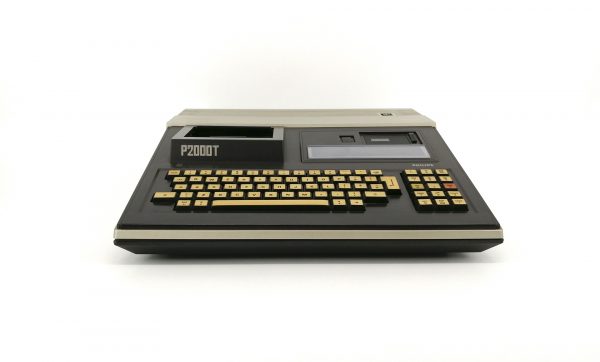
The Philips P2000T was Philips' first home computer, launched in 1981. This machine was ahead of its time in some ways.
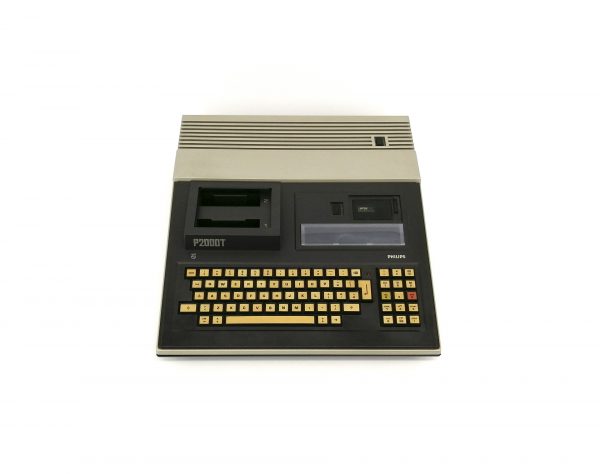
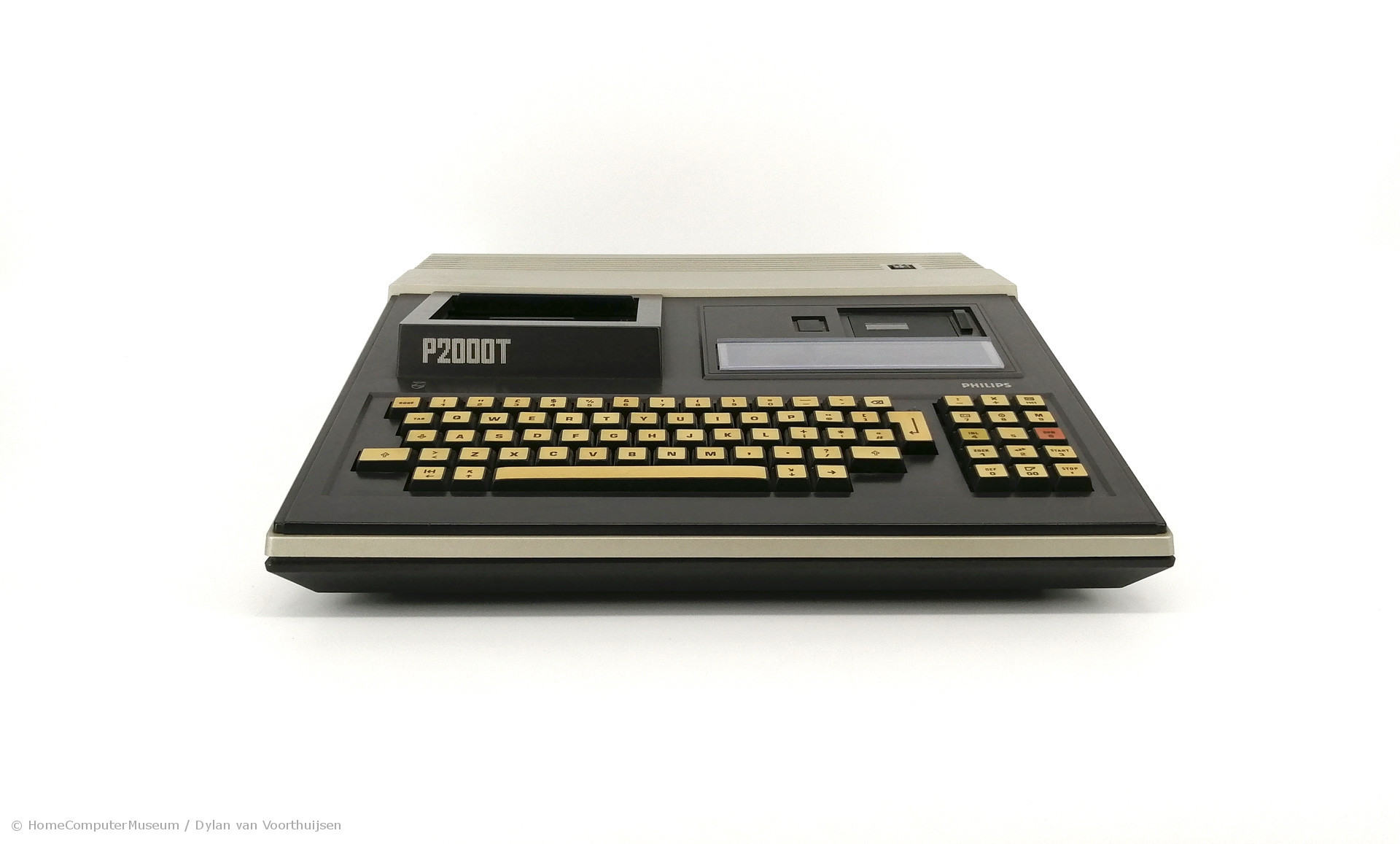
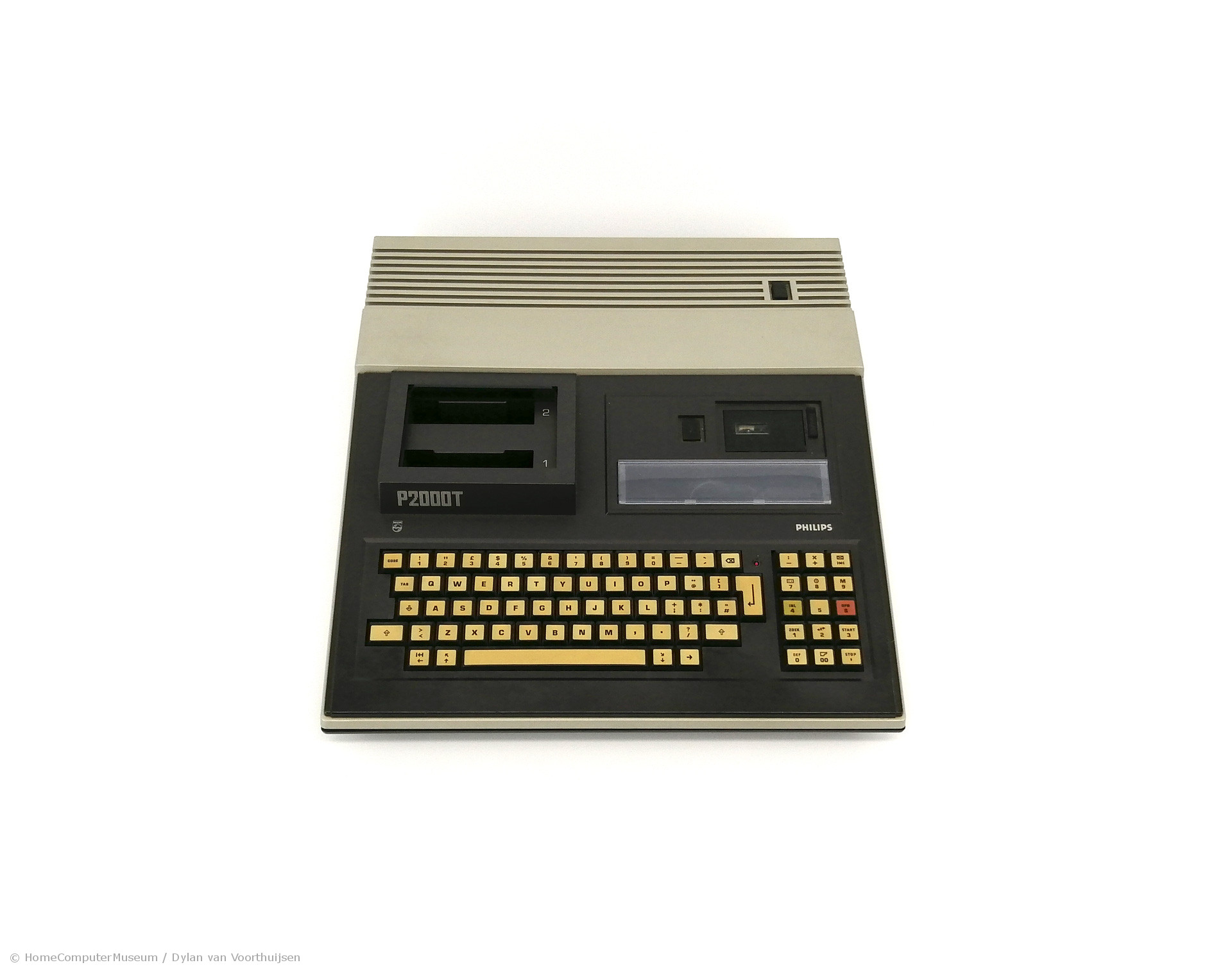
Philips P2000T
The Philips P2000T was Philips' first home computer, launched in 1981. This machine was ahead of its time in some ways.
P2000T, P2000M, and P2000
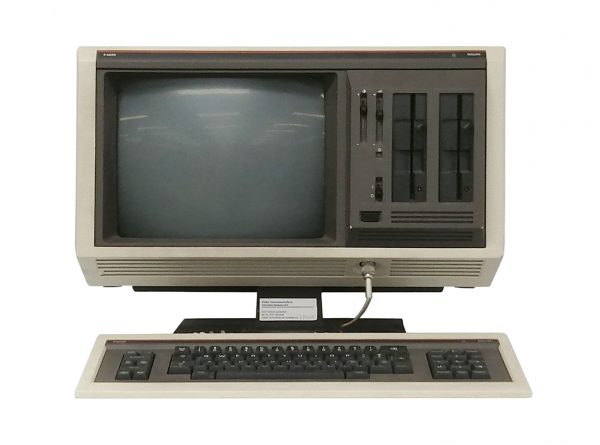
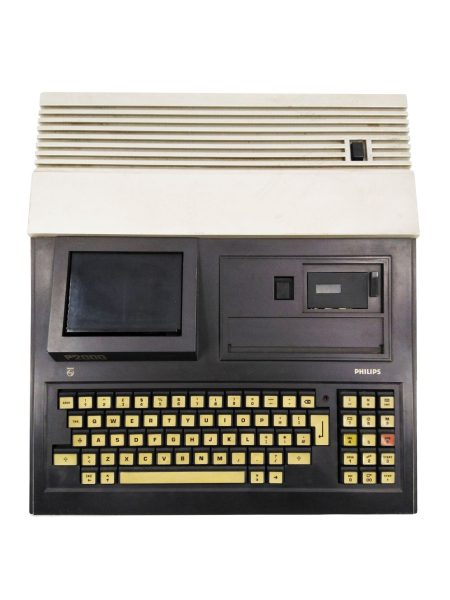
The original P2000 (without the T or M designation) were, as far as we know, used exclusively internally. They corresponded to the later P2000M and had the same internal model number (P2033). The P2000T had an internal model number of P2001.
The P2000T could be connected to a TV or via an RGB cable. The maximum resolution was 40 x 24 characters. The teletext chip was also the weak point of the machine because despite being able to display 8 colors and some graphic characters, it couldn't handle high-resolution or pixel-level control.
The P2000M and the original P2000 (type P2033) were aimed at the business market. These more professional variants didn't have a graphic chip but had a separate video board that could display 80 monochrome characters.
These machines also included a disk controller that could connect up to 2 drives of 5.25" (35 tracks, single-sided). These separate disk controllers could later be installed in a P2000T, and with some adjustments, a P2000M could also have the same graphic capabilities.
Both machines used a Zilog Z80 running at 2.5 MHz. The P2000M came with 16KB of RAM as standard, while the P2000T had options for 16, 32, or 80 KB (P2000/38, P2000/54, and P2000/102, respectively).
All machines had a built-in mini-tape drive. The advantage of this was that it was much faster than regular cassettes while still being relatively inexpensive, especially compared to the much more expensive floppy disk drives. A mini-tape could hold about 42 kB of information.
Use
The P2000 was also known as Philips' workhorse. It was a robust system that could take a beating, had relatively fast data storage with the mini-cassette, and was easy to connect. Additionally, Philips P2000T, mainly due to its robustness, was used in schools for educational purposes. It also found its way into many homes, primarily because people wanted to use it for Viditel.
A Viditel terminal cost around Fl. 1000. This device could only work with Viditel/Videotex. For Fl. 200 more, you could buy a complete computer. Since the P2000T (Television) was also easy to connect and the video chip was ideal for Videotex, the choice was relatively simple.
Philips Nat. Lab also formed a real computer club around this computer. The Nat. Lab Thuis Computer Club, later the P2C2. This contributed to the success of this machine in the Netherlands.
Other clubs also emerged, such as the GPC and the P2000gg. The latter operated under the banner of the Hobby Computer Club (HCC). The P2000gg quickly grew to nearly a thousand members. Enthusiasts were more strongly represented in the age groups of ten to thirty and forty to fifty. A small part of this thriving network of hobbyists developed BASIC programs for the device, further popularizing the P2000. The developed applications ranged from games to educational software and administrative programs. There were programs for creating embroidery patterns, book indices, and even faxing.
This was not the result of casual experimentation. The club had set up a system to improve each other's work, including forms to evaluate each other's programs, leading to iterative improvements and high-quality applications. These were distributed in various ways, such as copying tapes during gatherings and transmitting programs over the airwaves. For example, through the radio program HobbyScoop of the Dutch Broadcast Foundation (NOS).
The End
The P2000 was ahead of its time in some ways and coexisted with other famous machines of that era, such as various MSX, Commodore, Apple, and Atari models. However, like all technology that is no longer in use today, it was eventually surpassed. This was primarily due to the rise of IBM-PC clones that dominated the market as the 1980s came to a close, with their prices becoming affordable for home users.
The P2000 series also introduced the Philips P2000C (the portable) and the final entry in the P2000 series, the Philips :YES. After this, Philips discontinued the P2000 series and shifted its focus to IBM PC-compatible computers in the P3000 series. There was also a side venture into the MSX line, although it was more oriented towards gaming consoles, hence the name VG (Video Game).
Interesting Links