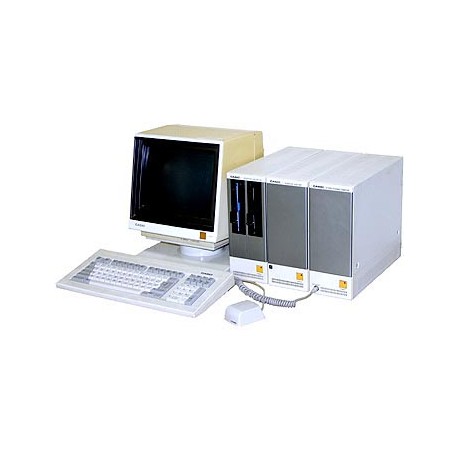

Casio FP‑1100
The Casio FP-1000/FP-1100 is a remarkable 8-bit computer developed by Casio Computer Co. and released in 1982.
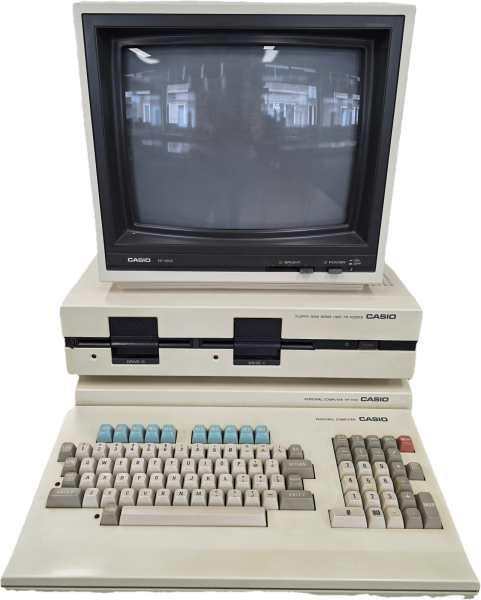
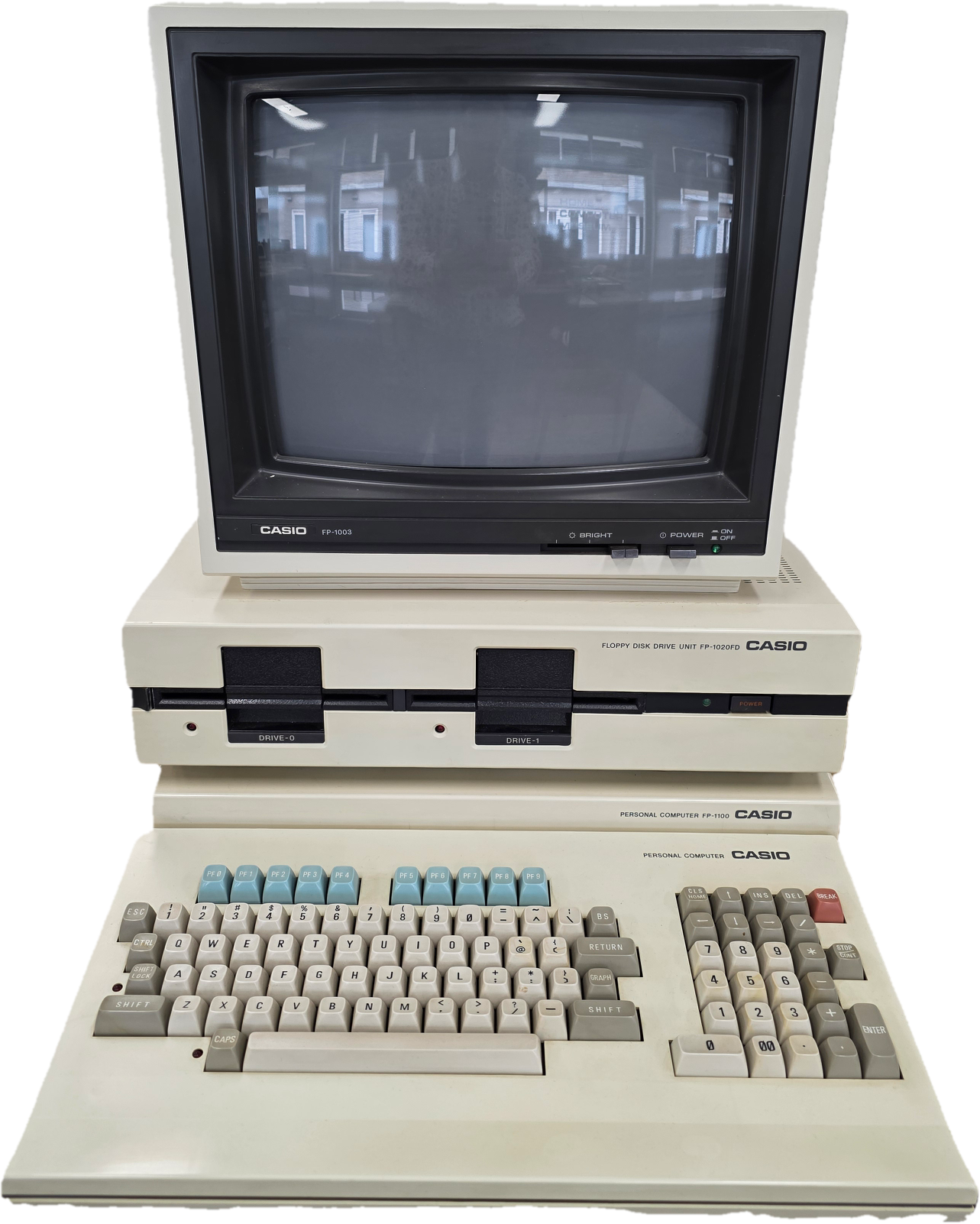
Casio FP‑1100
The Casio FP-1000/FP-1100 is a remarkable 8-bit computer developed by Casio Computer Co. and released in 1982.
Featuring a dual-CPU configuration—a main processor (Z80-compatible, 4 MHz) and a subprocessor (uPD7801G, 8-bit microcontroller, 2 MHz)—this machine delivered impressive performance. It included a fixed attached keyboard, 64 KB of main RAM, 48 KB of video RAM, and two cartridge expansion slots. The computer ran C82-BASIC, utilizing a BCD (Binary-Coded Decimal) format for internal numerical calculations.
Although the FP-1100 was technically among the top personal computers of its time, its price was surprisingly low: ¥128,000 (approximately €695.25). Casio clearly aimed to compete with the NEC PC-8000/PC-8800 series, which dominated the market at the time. With the optional FP-1060 expansion box, the number of expansion slots could even be extended to eight, making it ideal for serious users!
The BASIC interpreter of the FP-1100 was a proprietary development by Casio, with a strong focus on numerical calculations. Thanks to the BCD format, users avoided the common errors that occur when converting binary to decimal numbers. This made the FP-1100 particularly well-suited for business applications.
The BASIC supported not only double-precision (64-bit BCD) but also quadruple-precision (referred to as doubling-precision BCD), with
Unfortunately, the FP-1100 also had its limitations. Since the video RAM and keyboard were connected to the slower sub-CPU, applications that used these components ran slowly. As a result, action games were rare on this platform. Additionally, games designed for the dominant PC-8801 were seldom ported to the FP-1100, which did not help its popularity as a gaming computer.
uPD7801G @ 2 MHz